
Why Factory Verification Matters More Than the Price
Most import disasters do not start with a bad price. They start with a supplier that is not who they claim to be. A trading company posing as a factory will quote you a factory price, then mark it up and hope you never visit. Verification is the step that turns “I think this is a real manufacturer” into “I know it is.” For a small importer, one bad shipment can end the business — so the cost of checking is always smaller than the cost of not checking.
Step 1 — Check the Business License
Ask the supplier for their 营业执照 (business license) and match the company name, registration number, and registered address against what appears on their website, Alibaba store, and the stamp on their contract. In China the registered capital and “general taxpayer” status are public and tell you whether they are set up for export. A factory that hesitates to share a license, or gives a name that does not match their invoices, is a red flag on its own.
Step 2 — See the Production Line, Not Just the Showroom
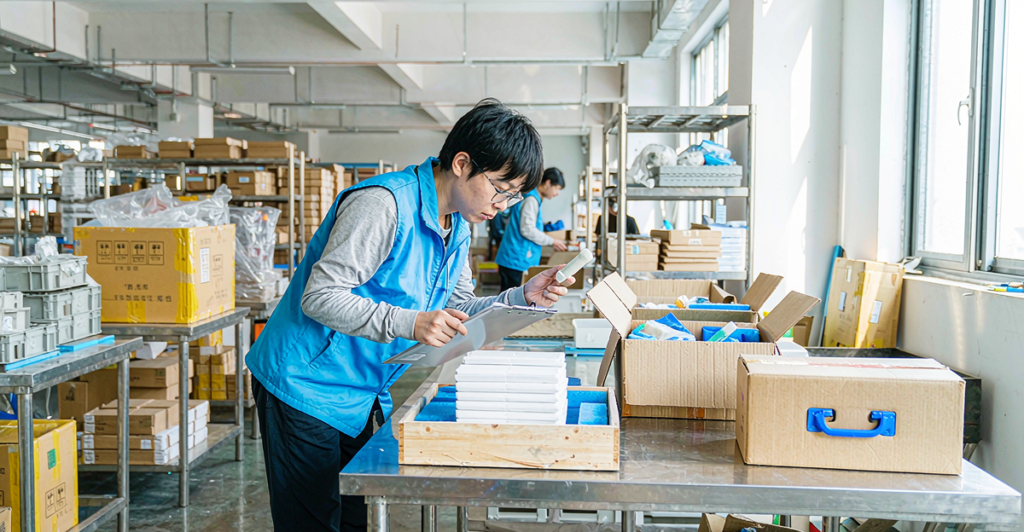
A showroom with samples proves they can source products — it does not prove they make them. Ask for a live video walk of the workshop, or better, a visit. Look for actual production equipment, raw material inventory, and workers in uniforms, not a clean meeting room with a few display units. If they “cannot show the line for security reasons,” that is usually code for “there is no line.”
Step 3 — Verify Export Records
A real export manufacturer can show you previous shipping records, export declaration forms, or references from overseas clients in your category. Ask how many containers they shipped last year and to which countries. Vague answers, or a refusal to share any proof, means you are likely talking to a middleman — which is fine if you know it, and dangerous if you do not.
Step 4 — Run an AQL Inspection Before Payment
Even a genuine factory can ship defective goods. Before you release the final balance, commission an AQL 2.5 inspection: a third party checks a statistical sample for function, appearance, quantity, and packaging, and sends a dated report with photos. If the batch fails, you hold payment and rework — instead of discovering the problem after it reaches your customer. This single step prevents most return and chargeback scenarios.
Step 5 — Watch for These Red Flags
Be cautious if the supplier refuses video calls, pushes you to pay 100% upfront, has no verifiable export history, or quotes far below market with vague specifications. None of these alone proves fraud, but together they are a strong signal to walk away or use an independent inspection before any money moves.
When to Use a Sourcing Agent Instead
If you are new to importing, verifying every supplier yourself is slow and easy to get wrong. A Shenzhen-based sourcing agent can visit factories, confirm licenses against the production line, and stay on site during your order — then inspect, consolidate, and ship it. The right agent protects your margin and your reputation; the wrong one just adds a layer of cost. The verification steps above are exactly how you tell them apart.
Need someone on the ground in Shenzhen to verify your supplier and inspect your order? See how our China sourcing services work — from factory verification to door-to-door shipping, with one partner.